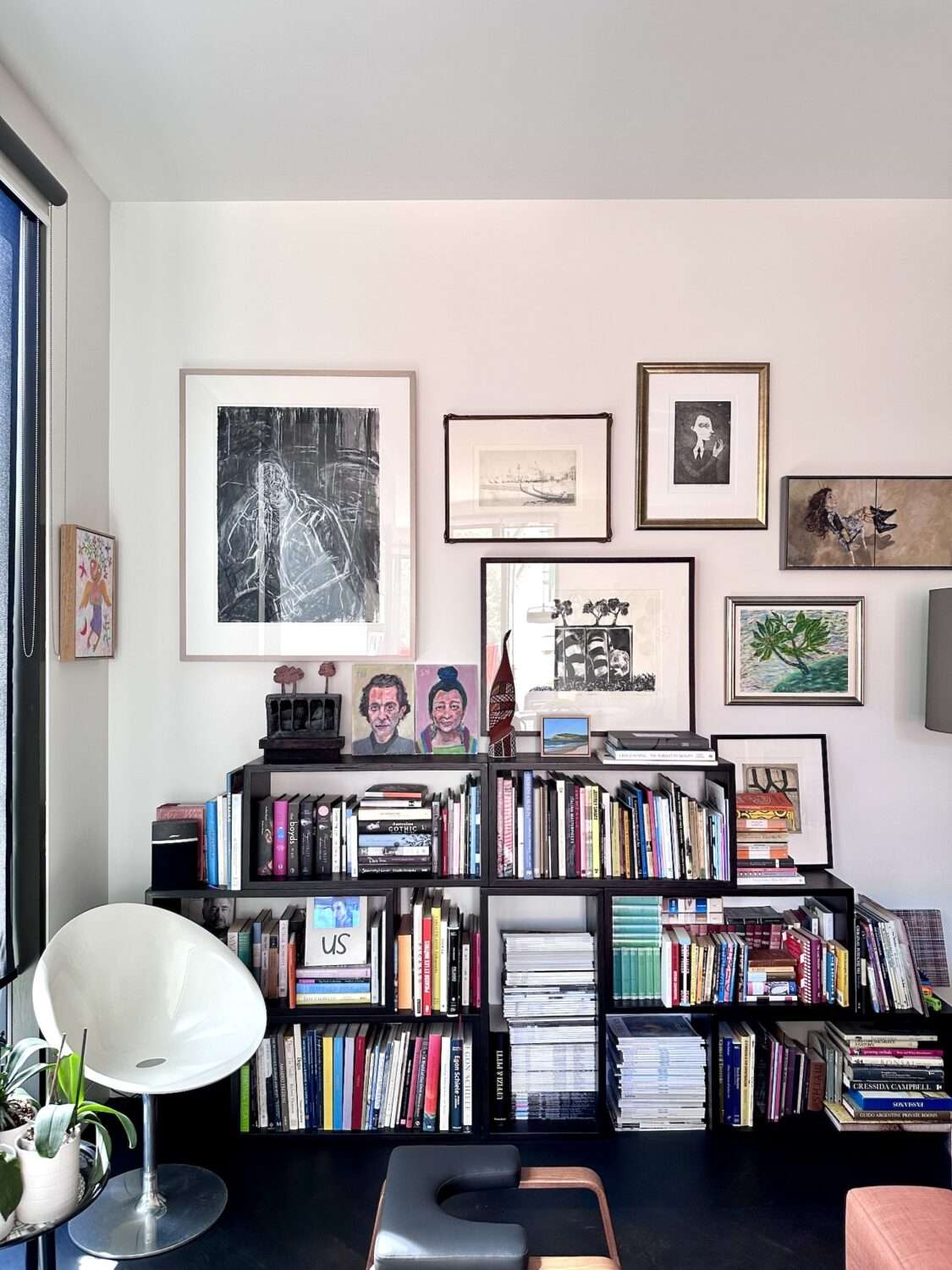
From left: Michael Leunig, David Fairbairn, Sir Arthur Streeton, Philip Davey, Jiri Tibor Novak, Takis Theodorou, Soula Mantalvanos and on the shelf sculpture by Philip Davey, portraits by Jim Pavlidis, Jilamara Artst & Crafts bird and etching, Lana Daubermann
Hopefully, we can open up a conversation about a little realisation my brain has been developing over the course of my creative career.
Questioning, dissecting and facing brutal truths is what I consider healthy planning.
As both an artist and a gallery owner, I spend a great deal of time thinking about the systems that support artists — and the ones that are quietly disappearing.
As a self-employed person with some hefty challenges in my day-to-day management that also affect my partner, Theo, I also dream a lot about the perks of not being self-employed.
Obviously, there are risks in all types of employment, but making your own livelihood is like jumping off a cliff every day and hoping the parachute opens… every day.
Daredevils!
Over the past few years, we have seen public funding for the arts tighten and, more recently, cease altogether. Commercial gallery closures are real, and opportunities for artists become more precarious.
But I wonder if another question deserves equal attention: was the ecosystem itself ever really supported?
Galleries and many artists are small businesses. They are run by people who take financial risks, advocate for artists or themselves, build audiences, and create the conditions for work to be seen, contextualised and sold.
Let’s rip that band-aid off
Many artists rely on galleries and community/cultural events at different points in their careers — yet (now take a breath, please, and allow me to explain further on…) I’m not sure artists support their own industry enough.
Do chefs eat at other restaurants? Do fashion designers buy clothes from their peers? Do authors buy books by other authors?
Are these questions relatable to my realisation?
I hope you’re writing your thoughts to share with me later.
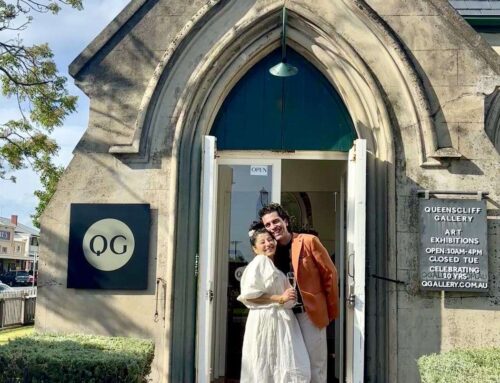
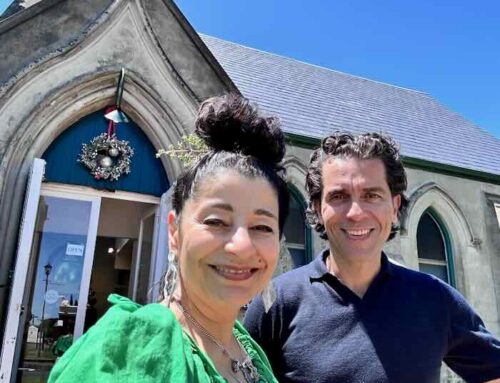
In the decade I’ve been running QG, this observation has grown so I can no longer look past it. And this is why I thought to get it out for discussion.
I’ve attended many openings, visited the homes of various creatives, and seen their collections. This also led me to realise that I just don’t think artists support their own industry well enough, and that actually, have they ever thought they needed to?
But I make the work.
Another huge factor that really bothers me is that arts education and artist culture have often framed commerce as suspect, collecting as elitist, and selling as selling out. These are extra factors to make artists feel uncomfortable about whacking a decent tag on their creations. Are these ideas leaving many artists disconnected from the economic structures that sustain the very industry they work in?
What I’m saying here is not a criticism, but an observation — and a conversation I believe is worth having. We might just save our industry if we budget with the arts in mind.
What’s wrong with having nice things?
Let me be up front about elitism: I LOVE DESIGNER, EXPENSIVE GOODS just as much as I love cheap finds. I enjoy using them, touching them, wearing them or just staring at them because someone made them.
I buy rarely. I buy well.
I budget my backside off to manage the self-employment that physically suits our situation, which takes a lot of sacrifice, and that I love dearly, my art and my most expensive addiction, travel.
Look! I’m trying to excuse my life – it’s insane!
Artists have been raised to be shy about selling their work and, worse still, pricing it appropriately. They are the first to donate their works to causes, or sometimes for no reason at all, which is the clearest way of saying, ‘my work isn’t worth that much’.
Swapping work, gifting, and supporting peers creatively are vital and generous practices. But they do not, on their own, sustain the artist, keep galleries and creative organisations open, staff employed, or exhibition programs alive.
This timidness costs the artist who pays with their reputation, which in turn means they lose out on building value for their ‘brand’ and our industry.
Transparency and clarity
My own art collection is largely made up of works purchased through Melbourne galleries, and some acquired on travels when I was a full-time Director of ooi, a very successful design business – my own again. Theo and I bought a lot of art, always through galleries. There are very few cases in which we acquired work otherwise because we fully understood the impact on our industry.
Of course, we have bought art from our own gallery now.
Understanding that we are all running small businesses, and recognising that a gallery sale supports both the artist and the infrastructure around them, might just be a sustaining element – if you want the gallery structure to exist. Times are changing. We also need to include this idea for open conversation.
Did we have too many restaurants pre-COVID? Was the gallery structure always going to fail? Are there too many galleries? Are there too many artists?
Shock horror
As artists, we can never be afraid to explore all ideas, even frightening ones. We are innovators. It’s these challenges that land us on our feet and make us and our work inspiring.
This is not a call to buy from my gallery. We need to think more deeply about how we support one another economically, not just creatively.
It is an invitation for artists to consider supporting all galleries, creative institutions, and organisations you love, when and where possible. It’s an invitation to rejig your budget and to speak with your wallet. It’s an invitation to think of all the ways you can support your own industry before you support another, perhaps???
Even one or two acquisitions a year would make a significant difference to our whole industry.
What about subscriptions? National galleries plug the arts to the general public – this is good for us. Are you a printmaker? Are you a member of the Print Council of Australia? What about the magnificent Baldessin Press? Do we want these places to fold?
We need to think about these things and do what we can.
I don’t have answers. I have experience as a self-employed business owner and an industry creative.
I have questions:
- How might artists support the ecosystem in ways that feel ethical, realistic, and aligned with their values?
-
What responsibility, if any, do we hold toward sustaining the spaces that support us?
-
How have you supported your industry?
- Gallery or self-representation?
I’m genuinely interested in hearing your thoughts and experiences. And, you could never offend me (just please don’t confuse rudeness with openness – there are ways to say things).
This blog is offered in the spirit of the classic artist: curiosity, respect, and care for the future of the arts.
Rather than hosting an online comment thread, I invite you to contact me directly. Responses can remain private or, with permission, be shared below after I collate responses. Include your preference if/when you send feedback.